

Temporary Staffing vs. Permanent Placement: What Your Business Actually Needs Right Now

Contents
Most hiring decisions are treated like HR decisions.
They are not.
They are business model decisions.
That distinction matters because the wrong hiring approach does more than create frustration. It drains cash flow, slows execution, burns out your team, and quietly creates operational instability that compounds over time.
Maybe your Operations Director resigned two weeks before a major launch.
Maybe you landed a large contract and suddenly need 20 additional workers by next month.
Maybe your leadership team has been trying to “make do” without filling a critical role for six months, and everyone can feel the cracks starting to form.
At some point, every business reaches the same crossroads :
Do you hire temporary staff to move quickly and stay flexible?
Or do you invest in permanent placement to build long term stability?
The answer depends less on the role title and more on what your business actually needs right now.
This guide breaks down:
- The difference between temporary staffing and permanent placement
- When each staffing model makes business sense
- Real cost and speed tradeoffs
- Current staffing market trends
- How businesses are combining both strategies successfully
- What to look for in a staffing partner
What Is the Difference Between Temporary Staffing and Permanent Placement?
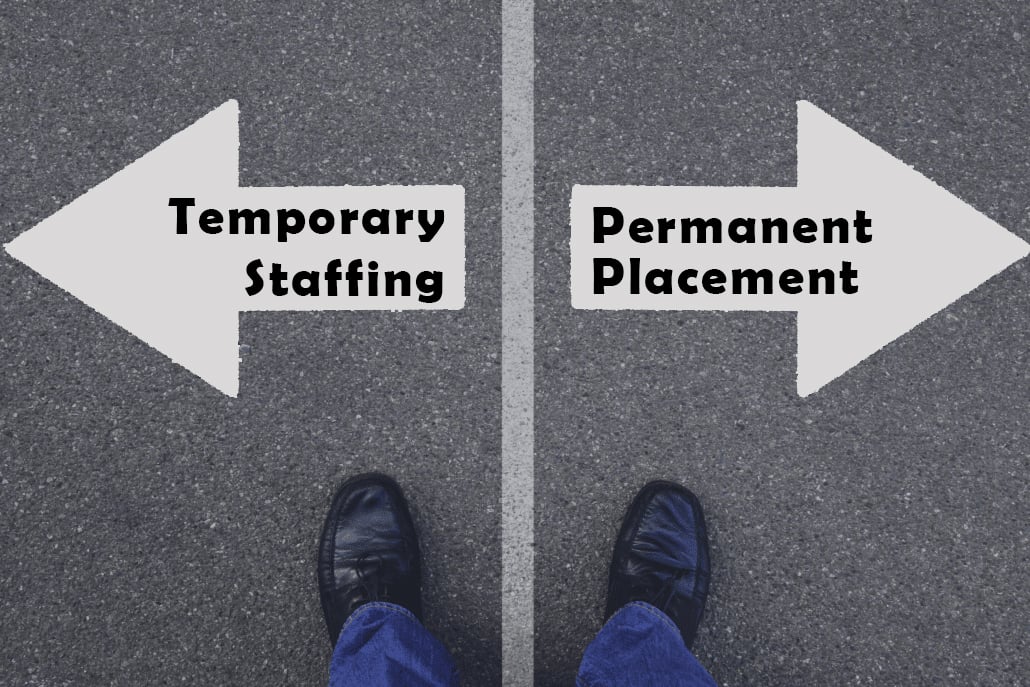
Temporary staffing provides workers for short term, project based, seasonal, or flexible workforce needs.
Permanent placement focuses on recruiting long term employees who become direct hires within your organization.
Simple definition.
Very different business implications.
Temporary Staffing Helps Businesses:
- Scale workforce capacity quickly
- Fill urgent gaps
- Reduce fixed labor costs
- Access specialized short term skills
- Manage seasonal or unpredictable demand
- Evaluate employees before making a permanent offer
Permanent Placement Helps Businesses:
- Build long term organizational stability
- Retain institutional knowledge
- Strengthen leadership continuity
- Improve culture alignment
- Support strategic growth initiatives
- Reduce long term turnover risk
The mistake companies make is assuming one model is “better.”
They solve different operational problems.
Is Temporary Staffing Growing in 2025?
Yes, and the data tells an important story.
According to the American Staffing Association, U.S. staffing companies employed nearly 2 million temporary and contract workers per week during Q3 2025. Staffing employment also recorded 14 consecutive weeks of year over year growth beginning in September 2025.
That matters because businesses are still investing heavily in workforce flexibility even while managing:
- economic uncertainty
- higher labor costs
- margin pressure
- shifting demand cycles
The market is stabilizing after contraction.
That is a signal.
Businesses are not abandoning temporary staffing. They are becoming more strategic about how they use it.
At the same time, staffing sales declined 8.5% year over year in Q3 2025.
Translation?
Staffing agencies are competing harder for business right now.
That gives employers:
- more negotiating leverage
- stronger service opportunities
- better pricing flexibility
- increased responsiveness from staffing partners
For buyers, this is one of the strongest staffing negotiation environments in years.
When Does Temporary Staffing Actually Make Sense?
A lot of business owners still associate temporary staffing with basic administrative coverage.
That is outdated thinking.
Modern temporary staffing supports:
- manufacturing
- logistics
- healthcare
- IT
- finance
- customer support
- engineering
- compliance
- operations
- project management
The real question is not whether the role is “important.”
The question is whether workforce flexibility creates business value.
1. You Need to Scale Faster Than Traditional Hiring Allows
A good staffing partner can often place qualified workers within 24 to 72 hours.
Traditional hiring rarely moves that quickly.
If revenue opportunity is moving faster than your recruiting process, temporary staffing becomes an operational advantage.
This is especially common in:
- seasonal hiring
- warehouse operations
- healthcare staffing
- project based work
- product launches
- rapid expansion periods
2. Your Demand Is Unpredictable
Hiring permanent employees for temporary demand spikes creates long term payroll problems.
Retail businesses experience this constantly during Q4.
Manufacturers see it when large orders hit unexpectedly.
Healthcare organizations deal with seasonal patient surges.
Temporary staffing allows companies to align labor costs with actual business demand instead of optimistic forecasting.
That flexibility protects margins.
3. You Want a Temp to Hire Strategy
One of the smartest workforce strategies today is temp to hire staffing.
Why?
Because interviews are performance theater.
Real work is real work.
A temp to hire model allows employers to:
- evaluate performance under pressure
- assess cultural fit
- observe communication style
- validate technical skills
- reduce hiring risk
After 60 to 90 days, you have real operational data instead of interview impressions.
That dramatically improves hiring accuracy.
4. Cash Flow and Fixed Costs Matter Right Now
Permanent employees create long term fixed costs:
- benefits
- payroll taxes
- PTO
- insurance
- onboarding costs
- equipment
- training investment
Temporary staffing shifts many administrative responsibilities to the staffing agency.
That cost structure matters during:
- growth phases
- uncertain markets
- cash preservation periods
- restructuring
- expansion initiatives
Especially in 2025, businesses are looking for ways to remain operationally agile without overextending financially.
Temporary staffing supports exactly that.
When Is Permanent Placement the Better Investment?
Some roles should absolutely be permanent.
Trying to fill them with revolving temporary talent creates instability that eventually hurts the business.
1. The Role Carries Strategic Influence
Leadership positions require continuity.
Examples include:
- Directors
- Controllers
- Senior Operations leaders
- HR leaders
- Sales executives
- Client relationship owners
These roles shape:
- culture
- decision making
- institutional knowledge
- customer relationships
- team performance
Replacing them repeatedly creates operational drag that compounds over time.
2. Your Industry Requires Long Term Continuity
Some industries depend heavily on compliance, licensing, trust, and relationship continuity.
Examples include:
- healthcare
- finance
- legal
- engineering
- government contracting
In these environments, permanent placement is often tied directly to risk management and organizational credibility.
3. You Are Building Long Term Infrastructure
If your company is:
- scaling
- launching a division
- transforming operations
- rebuilding culture
- entering new markets
then permanent hires become foundational decisions.
The people hired during growth phases often shape what the organization becomes later.
That deserves a serious recruiting process.
Temporary Staffing vs. Permanent Placement: Which Costs More?
This is where most articles give shallow answers.
The truth is more nuanced.
Temporary Staffing Usually Costs More Per Hour
You are paying a staffing markup that covers:
- recruiting
- screening
- HR administration
- payroll
- benefits
- compliance
- agency operations
That markup is real.
But so is the flexibility.
Permanent Placement Usually Costs More Upfront
Placement fees can feel expensive initially.
But over longer periods, strong permanent hires often become more cost efficient because:
- turnover decreases
- productivity improves
- institutional knowledge compounds
- onboarding costs stabilize
The key question is not:
“Which costs less?”
The key question is:
“Which staffing model aligns with the economic reality of this role?”
That is a completely different conversation.
Temporary Staffing vs. Permanent Staffing: Speed vs Stability
Here is the simplest way to think about it.
-Jun-11-2026-12-21-47-9798-PM.png?width=624&height=383&name=image%20(2)-Jun-11-2026-12-21-47-9798-PM.png)
How Do You Know Which Staffing Model Your Business Needs?
Choose Temporary Staffing If:
- You need people fast
- Demand fluctuates
- The work is project based
- Cash flow flexibility matters
- You are scaling cautiously
- You need specialized short term expertise
- You want to test candidates before committing
Choose Permanent Placement If:
- The role influences culture or strategy
- Turnover is expensive
- The role manages people
- Long term retention matters
- Institutional knowledge is critical
- Compliance or client trust is involved
- Stability is more important than speed
What Should You Look for in a Staffing Agency?
Honestly, the staffing model matters less than the quality of the staffing partner.
A strong staffing agency brings:
- an active talent pipeline
- faster recruiting infrastructure
- industry specific expertise
- screening and vetting capabilities
- replacement support
- operational scalability
A weak staffing partner creates more problems than they solve.
When evaluating staffing agencies, ask:
- What industries do you specialize in?
- What is your placement retention rate?
- How quickly can you fill roles?
- How do you source candidates?
- What happens if a placement does not work out?
- Do you support both temporary staffing and permanent placement?
Those answers reveal far more than pricing alone.
Why More Companies Are Using Both Temporary and Permanent Staffing Together
The most sophisticated workforce strategies use both models intentionally.
Example:
A manufacturing company may use permanent placement for:
- plant leadership
- engineering
- quality assurance
- operations management
While using temporary staffing for:
- production scaling
- seasonal demand
- project surges
- warehouse staffing
That combination creates:
- operational stability
- workforce flexibility
- cost control
- hiring agility
It also creates a stronger talent pipeline because companies can convert high performing temporary workers into permanent employees over time.
That blended strategy is becoming increasingly common in 2025.
What Happens When Businesses Choose the Wrong Staffing Strategy?
This is where workforce decisions become expensive.
Using permanent staffing where flexibility is needed creates:
- bloated payroll costs
- difficult layoffs
- reduced agility
- operational rigidity
Using temporary staffing where continuity matters creates:
- constant retraining
- weaker culture
- reduced accountability
- institutional knowledge loss
Neither mistake destroys a company overnight.
But both quietly compound.
That is why staffing strategy should be treated as an operational decision, not simply a recruiting decision.
Final Thoughts: Temporary Staffing and Permanent Placement Solve Different Problems
Businesses that hire effectively understand something important:
Every role does not require the same workforce strategy.
Temporary staffing is valuable when:
- speed matters
- flexibility matters
- scalability matters
- uncertainty exists
Permanent placement is valuable when:
- continuity matters
- leadership matters
- retention matters
- long term performance matters
The strongest companies use both strategically.
And increasingly, they rely on staffing partners who understand how to support both models under a unified workforce strategy.
Because hiring is not really about filling jobs.
It is about building a workforce model that actually supports how your business operates today and where it needs to go next.
If your organization is evaluating temporary staffing, permanent placement, or a blended workforce strategy, this is exactly the kind of decision worth slowing down long enough to get right.